
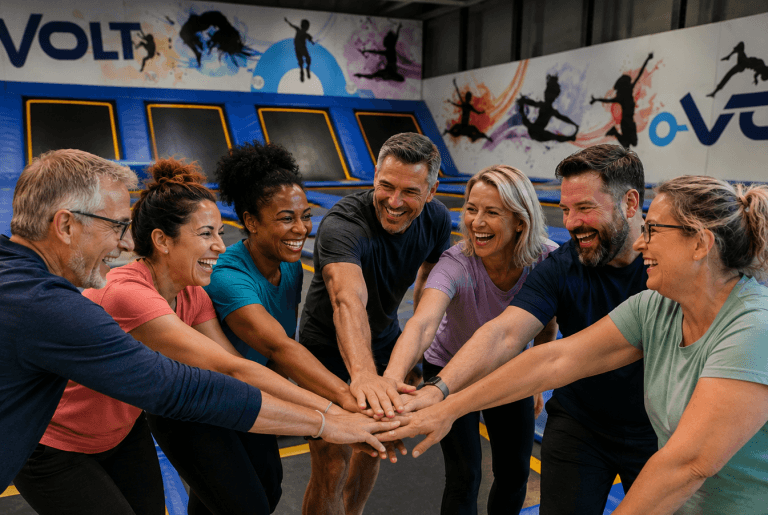
For a long time, coworker activities often came down to a dinner at a restaurant, an after-work happy hour, or a more traditional evening organized once or twice a year. Today, companies are looking more for experiences that create real human connections, reduce stress, and strengthen team cohesion naturally.
It’s in this context that active group outings are taking up more and more space, both in social clubs and in team building (Team building is a set of activities, exercises, or experiences organized to strengthen the bonds between members of a work team).
And contrary to what many people think, it’s not just about “getting employees moving.” Behind these activities are several very concrete effects on communication, motivation, workplace atmosphere, and even a team’s overall performance.
The ideas, concepts, and observations presented in this article are based mainly on recognized research and publications in human resources, organizational psychology, workplace mental health, and team dynamics. References related to the content covered in the article can be found at the end.
What is an active group outing?
An active outing is an activity where participants move, collaborate, interact, and share a common experience in a setting different from day-to-day work.
This can include:
- obstacle courses;
- accessible sports activities;
- collaborative games;
- indoor activity centers;
- team challenges;
- immersive experiences;
- physical activities adapted to all levels.
The goal isn’t athletic performance.
The real goal is to create a positive shared experience where people can interact in a different way than behind a screen or in a meeting room.
Social club and team building: what’s the difference?
The two concepts are often mixed up, but they don’t pursue exactly the same goals.
The social club
The social club is mainly about fun, relaxation, and human connection. Its role is to improve quality of life at work by offering employees enjoyable moments.
Social club activities can help, among other things, to:
- create a sense of belonging;
- break the routine;
- improve the overall atmosphere;
- encourage exchanges between coworkers;
- offer a beneficial mental break.
In this context, an active outing becomes a chance to laugh, switch off, and share a positive moment together.
Team building
Team building, on the other hand, goes a bit further.
These are activities designed to improve collaboration, communication, and how a team works.
The idea is simple: when you put coworkers in a different environment, where they have to cooperate, solve situations, or take on challenges together, several relationship dynamics naturally emerge.
You discover:
- other people’s strengths;
- communication styles;
- leadership instincts;
- the ability to support one another;
- the team’s human dynamics.
And often, these observations have a direct impact on the workplace atmosphere once you’re back at the office.
Why do active activities work so well?
Movement completely changes human interactions.
At work, exchanges are often structured, fast, and task-focused. Employees talk to handle files, reach goals, or respond to urgent issues.
In an active activity, barriers come down more easily.
People laugh more, talk spontaneously, and see each other from a different angle.
The brain also reacts differently when it’s in motion.
Light to moderate physical activity helps, among other things, to:
- reduce stress;
- reduce mental fatigue;
- improve mood;
- boost energy;
- encourage positive emotions.
Result: interactions often become more natural and more authentic.
A real impact on communication
Many workplace tensions don’t come from a lack of skill, but rather from a lack of communication.
Some people collaborate less simply because they don’t really know each other.
An active activity often helps create connections that would never happen in the normal work setting.
For example:
- a manager discovers an employee who really brings people together;
- two departments that rarely interact build a better relationship;
- more reserved coworkers step up more;
- conversations become smoother after the activity.
This kind of human connection often improves long-term collaboration.
And above all, it helps humanize professional relationships.
Reducing stress and preventing burnout
Psychological well-being at work has become a major issue.
High mental load, fast pace, hyperconnectivity, performance pressure: many teams experience significant stress, sometimes without even realizing it.
Active outings offer a real break.
They allow employees to:
- switch off mentally;
- step outside the professional setting;
- take the pressure off;
- enjoy a positive moment with no performance goal.
Even a few hours can make a big difference in a team’s energy and morale.
And unlike some more passive activities, active experiences encourage more emotional release thanks to movement and social interaction.
A sense of belonging: an often underestimated factor
An employee who feels connected to their team generally develops a stronger sense of commitment to their organization.
That sense of belonging isn’t built only through meetings or internal policies.
It’s also built through shared experiences.
Shared memories play a huge role in company culture.
A memorable activity can become:
- a running joke within the team;
- a conversation topic for months;
- a unifying moment;
- an experience that brings people closer.
And the more a team develops this kind of positive collective memory, the more the workplace atmosphere tends to improve.
The benefits of active activities for companies
The benefits go far beyond simple entertainment.
1. Improved workplace atmosphere
Teams that share positive moments together generally build better day-to-day relationships.
This can reduce:
- tension;
- conflicts;
- misunderstandings;
- the isolation of certain employees.
2. Increased motivation
A company that invests in human experiences shows that it values employee well-being.
This kind of attention often helps strengthen motivation and engagement.
3. Stronger collaboration
Collaborative activities help teams develop habits of mutual support that can then carry over into day-to-day work.
4. Onboarding new employees
Group outings are extremely effective for integrating new people into a team.
In a relaxed environment, conversations happen more naturally, and new employees often feel included much faster.
5. Promoting company culture
Companies that encourage human connection often create a stronger, more attractive culture.
Today, many workers are looking for an environment where they’ll feel good, not just a job.
A successful activity shouldn’t exclude people
This is essential.
A good group activity must be accessible and inclusive.
The goal is never to create excessive competition or make certain people uncomfortable.
The best activities are often the ones where:
- all levels can take part;
- the rules are simple;
- the atmosphere is relaxed;
- fun comes before performance;
- everyone can participate at their own pace.
When an activity is well adapted, even less athletic or more reserved people can enjoy the experience.
Do you absolutely need to organize big activities?
Not at all.
A common mistake is thinking you need to organize something huge or very expensive to have a positive impact.
Often, the best activities are simply well thought out.
What really matters:
- the quality of the experience;
- the atmosphere;
- accessibility;
- the feeling of being involved;
- the authenticity of the moment.
Even a few hours of activity can have very positive effects on a team.
Current trends in team building
Over the past few years, companies have been gradually moving away from very formal or overly corporate activities.
Employees are looking more for:
- real experiences;
- dynamic activities;
- relaxed environments;
- spontaneous moments;
- experiences that generate positive emotions.
Active activities are a particularly good fit for this new reality.
They allow teams to experience something together, rather than simply attend an activity.
The role of fun in performance
Fun is often underestimated in professional settings.
Yet teams that maintain positive, human relationships generally develop:
- better communication;
- more collaboration;
- greater resilience;
- a healthier atmosphere;
- better employee retention.
Creating enjoyable moments between coworkers isn’t superficial, then.
It’s a human investment that directly influences an organization’s day-to-day operations.
A new way to look at company activities
Active outings aren’t only meant to “entertain employees.”
They help strengthen essential elements for a team to function well:
- trust;
- communication;
- cohesion;
- a sense of belonging;
- collective well-being.
In a professional context where many employees are dealing with mental fatigue and human relationships sometimes become more distant, these moments become even more valuable.
And often, the strongest teams aren’t necessarily the ones that work together the most…
But the ones that have learned to build real human connections through positive, simple, authentic experiences.
If you want to organize a corporate outing at O-Volt, check out our page on CORPORATE GROUPS
———————————————————
References related to the content covered in the article:
- World Health Organization (WHO) – Mental health at work
Reference used for concepts related to workplace stress, psychological well-being, and the importance of healthy work environments. - CNESST – Psychosocial risks related to work
Used to support the sections on mental load, workplace atmosphere, and preventing burnout. - Harvard Business Review – The New Science of Team Chemistry
Source related to team cohesion, collaboration, trust, and human dynamics within teams. - Gallup – Employee Engagement and Performance
Used for concepts of belonging, employee engagement, and the impact of human relationships on performance. - Mayo Clinic – Exercise and stress: Get moving to manage stress
Reference used for the effects of movement and physical activity on stress, mood, and mental well-being. - Government of Canada – Physical activity and mental health
Used for the psychological and social benefits linked to physical activity. - McKinsey & Company – The value of belonging at work
Reference used for concepts of company culture, belonging, and interpersonal relationships at work. - Deloitte – Global Human Capital Trends
Used for modern trends in people management, employee experience, and the importance of human interactions at work.