
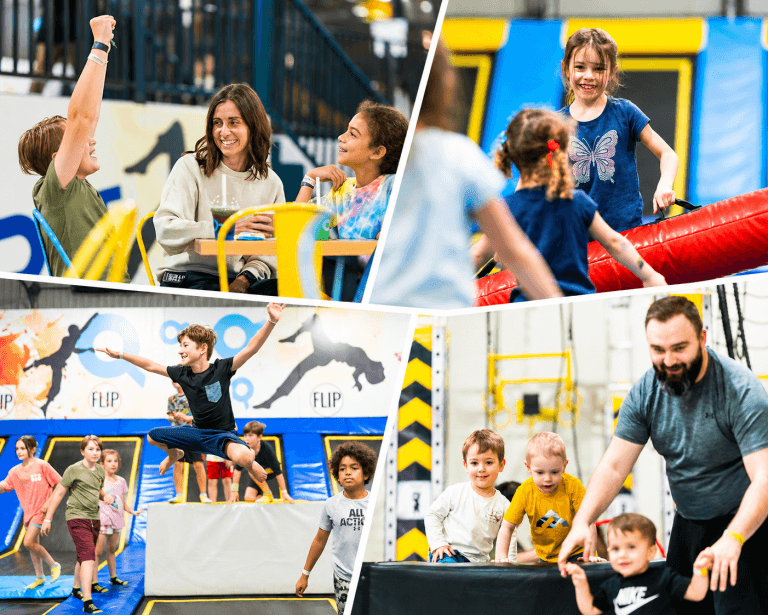
Ask an adult what starts in the fall.
They’ll probably say: back to school. Lunches again. Homework. After-school activities. Appointments you have to start putting back in the calendar. Winter tires you’ll need to think about soon.
Now ask a child.
You might get a much more interesting answer.
Leaves you can jump into. Halloween coming up. New friends in class. Getting your favourite sweater back. The perfectly reasonable possibility, in their mind, of eating a caramel apple on a Tuesday.
Same season. Two worlds.
What if, this fall, we borrowed a little from the second one?
Kids don’t really see activities. They see possibilities.
An adult walking into an indoor activity centre quickly sees the facilities.
A trampoline. A course. A court. Obstacles.
A child, on the other hand, didn’t necessarily get the memo telling them to use each thing exactly as intended.
The Ninja course can become a spy mission. A trampoline can be used to decide who can pull off the weirdest jump. Dodgeball can suddenly become an extremely serious showdown between two teams whose names were just invented.
That may be one of the most interesting differences between how kids play and how adults play: we often look for what we’re supposed to do; they look for what they could do.
And that nuance changes a lot.
“Watch me!” is probably one of the most important phrases of the fall
Every parent knows it.
“Watch me!”
It usually comes at the exact moment you’re looking somewhere else.
And when you finally look, the feat in question might be spectacular… or it might be jumping about 14 centimetres higher than five minutes ago.
Either way.
Because “watch me” rarely means only “look at what I’m doing right now.”
It can also mean: I tried something. I did it. I’m proud. I want to share this with you.
That’s a different way to approach a family outing this fall: not only asking what we’re going to do, but what we might get to see happen.
A bit of boldness. A new skill. A small win. Or a child doing the exact same thing twelve times because this time, “it was almost perfect.”
For a child, progress doesn’t always look like progress
We like results that are easy to measure.
Faster. Higher. Longer. Level cleared.
Kids sometimes make progress in a much less spectacular way.
The one who watched others for ten minutes finally dares to try. The one who gave up after a failure tries again. Another figures out how to control their movement better. Two kids who don’t know each other spontaneously find a way to play together.
None of that necessarily earns a medal.
And yet, those are real learnings.
The Canadian 24-Hour Movement Guidelines recommend that children and youth aged 5 to 17 get at least 60 minutes of moderate-to-vigorous physical activity daily, in addition to several hours of light physical activity.
But behind the minutes and the recommendations, there’s something much more concrete: giving young people enough opportunities to move so they can discover what their bodies are capable of.
And sometimes, it simply starts with: “I’m going to try.”
Fall doesn’t have to become a giant to-do list
Let’s be fair to adults: we have a good reason to love calendars.
Without them, someone would inevitably show up to hockey on Thursday when practice was Wednesday.
The problem starts when the whole season is scheduled down to the minute.
School. Work. Groceries. Homework. Practice. Dinner. Bath. Bed. Repeat.
Then Saturday arrives, and this question:
“What are we doing today?”
Our first instinct is sometimes to look for the right activity.
A child isn’t necessarily looking for the right activity. They’re looking for a story to tell on Monday morning.
And that’s not the same thing.
The perfect outing probably doesn’t exist. Good.
Here’s some great news: you don’t need to create a memorable moment.
In fact, trying really hard to create a “MEMORABLE FAMILY MOMENT” is probably one of the most effective ways not to create one.
Family memories have an annoying habit of choosing for themselves what’s worth keeping.
You plan an amazing outing: nobody mentions it again.
Dad loses miserably in a Gladiator duel against his eight-year-old daughter: the story comes back at Christmas for four years.
The memory might be a particularly graceful fall. An immediate demand for a rematch. A first success. An absurd line tossed between two jumps.
What matters isn’t necessarily the exceptional event.
It’s often the unexpected in the middle of an ordinary day.
And what about screens in all this?
It’s impossible to talk about kids’ world without screens coming up. Phones, tablets, consoles, and videos are part of their everyday life. Demonizing them won’t make them disappear.
The most recent Canadian data available also shows the challenge is still very real for teens: youth aged 12 to 17 spend an average of 10.6 hours per day in sedentary behaviour, and only 22% meet the Canadian physical activity recommendations.
So maybe the more interesting question isn’t: “How do we keep kids away from screens?”
It could instead become:
“What will make them want to forget about them for a while?”
Important nuance.
Because a child running toward their next challenge usually doesn’t think they’re being forced into a “healthy lifestyle habit.”
They’re busy.
And that’s just fine.
Try a little experiment this fall
On your next outing, let your child decide part of the plan.
Not all of it. Let’s be reasonable.
But give them a mission: choose a challenge they’ve never tried.
Then switch the roles slightly.
They have to pick one for you.
You might discover another fascinating feature of childhood: kids take a wildly disproportionate amount of pleasure in watching their parents try something they don’t have down yet.
Enjoy it.
Nowhere does it say adults always have to be the ones who know how it works.
This fall, let’s try to see what they see
A child doesn’t walk into O-Volt thinking they’re here to hit their daily physical activity quota.
Thankfully.
They see something to try, someone to challenge, a move to land, or a place they haven’t explored yet.
What if experiencing O-Volt differently this fall was simply that?
Not trying to fill a day. Not trying to manufacture the perfect memory. Not turning every activity into a goal to reach.
Just leaving a little room for curiosity.
Next time, instead of asking “What do you want to do?”, try:
“What have you never tried?”
The answer might surprise you.
And if it leads to a Ninja course, a trampoline, a duel, or something you don’t even know the name of yet, you can always take a look at the activities offered at O-Volt. And for kids who discover that trying once definitely isn’t enough, O-Volt classes also make it possible to explore certain disciplines further.
——————————————————————————————————–
References
Public Health Agency of Canada. (2026). Physical activity: Be active for your health. Government of Canada. This page confirms, among other things, the recommendation of at least 60 minutes per day of moderate-to-vigorous physical activity for children and youth aged 5 to 17.
View the source in French – Government of Canada
Public Health Agency of Canada. (2024). The health of youth in Canada: A portrait of mental health. Government of Canada. See in particular Chapter 7: “Physical activity, screen time and sleep”, which covers physical activity, sedentary behaviour, screen time and sleep among youth in Canada.
View the report in French – Government of Canada
ParticipACTION. (2024). 2024 edition of ParticipACTION’s Physical Activity Report Card for Children and Youth. The full report in French summarizes available Canadian data and assesses various indicators related to children’s and youth physical activity.
View the full 2024 Report Card in French – ParticipACTION