
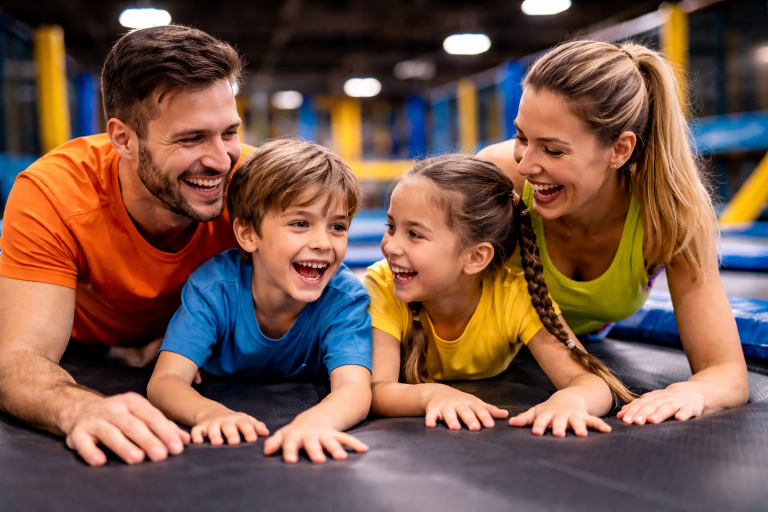
When Activity Becomes a Bonding Moment, Not an Obligation
We often talk about the importance of getting children active. We talk less about how they move… and especially with whom. Yet, the difference is significant.
When a child engages in physical activity alone or supervised only by adults in positions of authority (coaches, instructors, teachers), they develop certain skills. But when parents actively participate, learning goes far beyond simple movement.
Moving together transforms an activity into a bonding experience. And what children gain from it far exceeds the energy expenditure.
The Parent as a Role Model, Not a Spectator
In many families, parents naturally adopt the role of spectator: they observe, encourage, applaud. This role is useful, but it remains passive.
When the parent gets involved, even awkwardly, the child no longer just sees an adult supervising. They see:
- a role model,
- a partner,
- a human being who tries, sometimes fails, often laughs.
This shift in perspective is fundamental. The child understands that physical activity is not a performance to achieve, but a shared process. There are no longer “those who know” and “those who learn,” but people experiencing something together.
Learning by Example: A Powerful and Underestimated Tool
Children learn much less from what they are told than from what they observe.
A parent who:
- tries without being perfect,
- accepts falling, starting over,
- shows perseverance without putting pressure on themselves, sends strong messages, often without realizing it.
These messages are simple, yet foundational:
- You have the right to try.
- You don’t need to be good to have fun.
- Effort matters more than the result.
These are lessons that extend far beyond physical activity. They are rooted in confidence, self-esteem, and the relationship with effort.
Strengthening Emotional Security Through Active Presence
For a child, a parent’s presence in an activity acts as an emotional safety net.
This doesn’t mean the child is afraid or lacks autonomy. On the contrary, this presence often allows them to dare more:
- try a new move,
- take on a small challenge,
- step out of their comfort zone.
Why? Because the parent is not there to judge, but to share.
The child knows that in case of hesitation, doubt, or minor frustration, they can turn to a reassuring figure without interrupting the experience. This emotional security fosters exploration and natural learning.
Developing Cooperation Rather Than Comparison
In many sports contexts, children are quickly confronted with comparison:
- who is the fastest,
- who jumps the highest,
- who succeeds on the first try.
When parents participate, the dynamic changes. The activity becomes more often cooperative than competitive.
- We help each other.
- We laugh at mistakes.
- We celebrate small successes.
This approach teaches the child that movement can be a space for collaboration, not judgment. This is particularly beneficial for more reserved, less competitive children, or those sensitive to performance pressure.
Creating Lasting Emotional Memories
The most significant childhood memories are not always linked to exceptional events. They are often associated with emotions experienced together.
A parent who moves with their child creates:
- embodied memories (the body remembers),
- emotional memories (the bond strengthens),
- narrative memories (we talk about them, we remember them).
Years later, the child may not precisely remember the activity, but they will remember this feeling: “We did it together.”
A Real Impact on Long-Term Motivation
Studies and field observations converge on one point: children who associate movement with positive shared experiences are more likely to:
- stay active as they grow up,
- perceive physical activity as enjoyable,
- not abandon it in adolescence.
Why? Because movement is not perceived as an external obligation, but as a source of pleasure and connection.
Here, the parent plays a key role, not as a verbal motivator, but as an experience companion.
No Need to Be Athletic to Do Well
This is often the number one hurdle for parents:
“I’m not athletic.”
“I’m not good.”
Good news: it’s absolutely not a prerequisite. Children don’t expect parents to excel. They expect them to be present, sincere, and engaged.
A parent who laughs at their clumsiness sends a much more powerful message than a high-performing but distant parent. What matters is not physical ability, but the quality of presence.
Rethinking Family Activity Time
Moving together doesn’t necessarily require more time. It primarily requires a different intention.
It’s not about adding another activity to an already busy schedule, but about transforming existing moments into opportunities for shared movement:
- an outing,
- a spontaneous game,
- an impromptu challenge.
These moments, even short ones, have a profound impact when experienced together, without screens, without pressure, without performance goals.
Moving Together, Growing Together
When parents actively participate in their children’s physical activities, they don’t just help them move. They contribute to:
- strengthening family bonds,
- building confidence,
- normalizing effort,
- creating lasting memories.
In a fast-paced world where screens take up a lot of space, these shared moments become precious. They remind us of one essential thing: movement is even richer when experienced together.
And sometimes, the most beautiful gift a parent can offer is not a perfect activity, but simply their presence… in motion.