
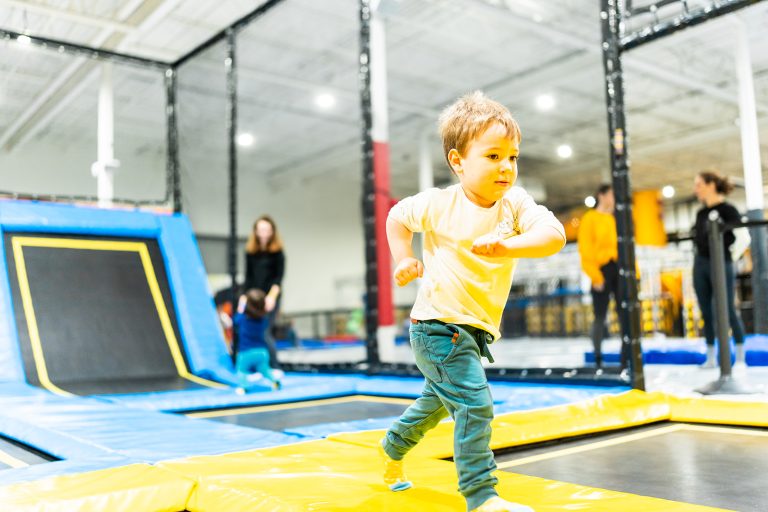
Between ages 0 and 5, a child doesn’t just grow… they’re being built. Every movement, every exploration, every active game helps lay the foundation for their overall development. Too often, motor development is still seen only as physical ability. Yet it plays a central role in learning, emotions, and self-confidence.
Here’s a clear, accessible guide—grounded in current kinesiology knowledge—to better understand, and above all better support, toddlers’ motor development.
This article was written based on:
- Official Canadian and international recommendations
- Current principles in kinesiology and motor development
- Best practices in motor stimulation for children
- A plain-language approach to make the information accessible to parents
What is motor development in children?
Motor development refers to all the skills a child acquires to move and interact with their environment.
We mainly distinguish:
- Gross motor skills: crawling, walking, running, jumping
- Fine motor skills: handling, grasping, hand coordination
From the very first months of life, movement directly stimulates the brain. Each new skill strengthens neural connections. In short: moving is learning.
Why ages 0–5 are a key period
This period is crucial because it influences:
- Posture and balance
- Coordination
- Spatial awareness
But also:
- Concentration
- Emotional regulation
- Self-esteem
An active child develops a better understanding of their body, which helps them interact more effectively with their environment.
The link between movement, cognition, and emotions
Motor development never happens in isolation.
For example:
- Climbing requires planning your movements
- Jumping develops rhythm and coordination
- Playing with other children builds social skills
Movement also directly influences confidence. Every success—even a small one—reinforces a sense of competence. Conversely, a lack of opportunities to move can limit this progress.
Major motor development milestones (0 to 5 years)
Every child develops at their own pace, but certain milestones help you gauge progress.
0 to 12 months
- Rolling over
- Crawling
- Sitting up
- Pulling to stand
1 to 2 years
- Walking
- Climbing stairs with help
- Pulling or pushing objects
2 to 3 years
- Running
- Jumping in place
- Throwing a ball
3 to 5 years
- Jumping with control
- Standing on one foot
- Completing small obstacle courses
Should you be concerned?
Variations are normal. However, some signs deserve attention:
- Little interest in movement
- Significant coordination difficulties
- No progress over several months
In these cases, a professional assessment may be appropriate.
Active play: the foundation of motor development
Active play is the primary tool for motor learning in children.
Two approaches complement each other:
- Free play: spontaneous exploration
- Structured activity: guided with a goal
Free play fosters independence and creativity. Supervision, on the other hand, helps develop specific skills.
Learning through play: an effective strategy
Fun plays a key role. When a child associates movement with a positive experience, they repeat the action, which speeds up learning.
How much should a child move?
Recommendations suggest:
- Several active periods per day for babies
- At least 3 hours of daily activity (spread out) for ages 1 to 5
The environment: a major lever
The setting a child grows up in directly influences their development.
A stimulating environment includes:
- Safe spaces
- Varied surfaces
- Structures to explore
Essential movements to encourage:
- Jumping
- Climbing
- Crawling
- Swinging
- Rolling
A variety of experiences supports more well-rounded motor development.
Safety and exploration: an essential balance
Letting a child explore involves some risk… and it’s necessary.
This is what we call managed risk.
A well-supervised environment makes it possible to:
- Experiment without major danger
- Develop independence
- Learn to manage their limits
An adult’s role is to guide and keep things safe, but not to overprotect.
Long-term benefits
Strong motor development influences many areas of life:
- Better concentration at school
- Greater ease in physical activities
- Better overall health
Conversely, a lack of activity can lead to:
- Coordination difficulties
- Lower confidence
- A tendency to avoid challenges
Can motor delays be caught up?
In most cases, yes.
Young children’s brains have a strong capacity to adapt. With appropriate, regular, and stimulating activities, progress can be significant.
Parents’ role in everyday life
Parents are key players in motor development—without needing to be specialists.
Simple activities to try:
- Obstacle courses using everyday items
- Ball games
- Dancing
- Balance games
Avoid:
- Constantly overprotecting
- Comparing them to other children
- Replacing active play with screens
To encourage a less active child:
- Focus on fun rather than performance
- Offer achievable challenges
- Join in with them
Active environments as a driver of development
Some environments offer especially favorable conditions for motor development.
In places like O-Volt, children benefit from:
- A variety of facilities
- Challenges adapted to different levels
- A setting designed to move safely
Real, tangible benefits:
- Trampolines improve balance and coordination
- Courses build agility and planning
- Play structures encourage exploration
The role of fun in learning
Fun acts as a catalyst. A child who’s engaged and having fun learns faster and develops a positive relationship with physical activity.
A safe, stimulating environment
Proper supervision makes it possible to:
- Test your limits
- Progress at your own pace
- Build confidence
The importance of social interactions
In these settings, interactions between children encourage:
- Imitation
- Motivation
- Social development
The key takeaway
One thing comes up again and again: movement is fundamental. What’s often underestimated today is just how much moving influences far more than the body. It’s a driver of overall development.
Every movement matters
Between ages 0 and 5, every movement matters. Every active experience helps build a child’s physical, cognitive, and emotional foundations.
Providing opportunities to move, in a safe and stimulating environment, isn’t a luxury—it’s a necessity.
And in many cases, it all starts simply by letting the child… play, explore, and move freely.
Key references
- Canadian Society for Exercise Physiology (CSEP)
Canadian 24-Hour Movement Guidelines for Children (0–4 years)
→ Recommendations on physical activity, sleep, and sedentary time in young children. - World Health Organization (WHO)
Guidelines on physical activity, sedentary behaviour and sleep for children under 5 years of age
→ International standards on the importance of movement from early childhood. - Naître et grandir
→ Essential Quebec reference for children’s overall development (motor, cognitive, social, emotional). - Institut national de santé publique du Québec (INSPQ)
→ Publications on early childhood development, healthy lifestyle habits, and physical activity.
Motor and overall development
- Centers for Disease Control and Prevention (CDC)
Developmental Milestones
→ Developmental milestones in children (0–5 years). - American Academy of Pediatrics
→ Recommendations on physical activity, active play, and overall development. - Canadian Paediatric Society
→ Resources on motor development and healthy habits in children.
Scientific and kinesiology-based approach
- National Institute of Health (USA)
→ Core concepts of motor development and movement-based learning. - Developmental Physical Education for All Children
→ An educational approach to motor development in young children.
Active play and environment
- ParticipACTION
→ Canadian data on children’s physical activity and its impacts. - Association des camps du Québec
→ Best practices for supervision, safety, and development through play.